


0. EP COVER 1. Dead Sound on the Radio 2. Boy in a Tower
3. Snake Oil / Tin Foil 4. The Masquerade 5. On the Air 6. Sound Collages
The Masquerade

While some songs come together pretty quickly from their original idea, others are pieced together slowly over time, and are compiled from multiple competing ideas. The Masquerade is my angry waltz about my frustrations with societal gender norms, and it is the second song I completed for my “On the Air” EP. The song isa bit more of the ‘pieced together’ kind, than the ‘it appeared overnight’ kind. It’s also my personal favorite out of all the songs on the EP.
Since the actual idea for the song came from a lot of different sources, you’ll have to bear with me for a little while before I get to talking about the song proper, as I have to run through all the different strings I had to knot together.
The initial chord progression came together at around the same time that I wrote the original full draft of “Dead Sound on the Radio”, in early summer 2024. It was originally written 2 whole steps up from where the final version ended up being (in C#m rather than in Am), and was originally intended to be an instrumental. I wrote it initially to be an impression of an early draft of a D&D character I was working on at the time, named Arachne. When I originally came up with her, she was a slightly creepy forest dwelling spider druid (think of a stereotypical, creepy, Victorian child, holding a broken baby doll), so It was soft, higher pitched, and a lot more ‘dreamy’ sounding, for lack of a better term.
Here’s a recording of what the original instrumental sounded like. I never recorded it when I came up with the idea, so I’m probably missing parts of it. Nonetheless, here’s a sloppy version of it played as well as I can remember. The original name for it was “The Dreamweaver.”
The concept for the lyrics of “The Masquerade” started as a completely different scrapped poem from about a month after I wrote the Dreamweaver idea. I never titled the poem, and I never developed it past the first couple lines, but it was one of those ideas that strung itself into the back of my head for weeks after I made it, until it eventually turned into something else. The poem went as follows:
“Pretend like they’re watching.
Make sure they see
all of the things that you’re supposed to be
Pretend like they’re watching
Put up your hair
Lining your eyes, write a disguise, So they won’t care”
I really liked the imagery, but I just wasn’t sure what to do with it. I wanted to write a poem both about how many people think more about their appearance than they should, to the point where it brings them mental stress; and simultaneously a poem that talks about the experience of trying to hide your mental health problems from the people around you in an attempt to keep them from worrying. Every time I tried to develop it past these first couple lines though, I was never happy with the result. So this fragment just sat rotting in a Word doc.
The mask imagery for the song was inspired by my love of the 2017 game Hollow Knight. Hollow Knight (and its sequel Silksong) are two of my favorite games of all time, and pretty much every character in the settings for both games wear pale white masks. This is because in the setting for the series, masks are what focus different characters’ minds and personalities into who they are, giving them their ‘faces’ so to speak. So (save for a few exceptions), characters without masks are essentially mindless drones until a mask is made for them. I’ve always been very taken by this idea, and so I specifically turned it on its head when I went to write “The Masquerade” (plus, I just wanted to find a way to incorporate masks in some way anyway, because I really like them as a design element).
The final tug that knotted all of these disparate threads together into one song was when some close friends of mine came out to me as trans towards the end of the summer in 2024. In the week or so that followed, I was incredibly excited for them, and I wanted to make something so that they’d know I was there for them. This was, however, also when the 2024 election season started to ramp up in intensity heading into the fall. I don’t think there was a specific comment or clip that pissed me off enough to write the song. Instead, I think it was the emotional whiplash of going from being extremely excited for my friends, to very suddenly and aggressively seeing Donald Trump—as well as other right wing and centrist talking heads—calling trans people a national threat, and trying to restrict their ability to move through the world and their access to basic functions. It also brought back memories of when I was a little boy who loved having long hair (cuz I’ve always liked rock music, and also donating my hair to charity), and how some people felt the need to tell me to cut it, or certain people would drastically change the way they treated me if they thought I was a boy vs a girl. I’ve always hated all of that, because who are you to tell me how long my hair should be? It’s not yours is it? So I decided that I needed to write another protest song.
The songwriting process for “The Masquerade” was actually rather straightforward once it clicked. I wrote the bulk of the song in about two, four-ish hour sessions split over two days, threading all of these disparate ideas together. On the first day, I wrote out a sketch of the song with three verses and choruses that went:
Verse 1
“With a skip and a step
She twirls to the left
Her golden hair flowing
With a smile that’s rehearsed
She looks so immersed
In her head, she’s absent”
chorus 1
“Don’t be too bold
Go fit the mold
Smile for them all
Stay young
For the masquerade”
verse 2
“With a leap
And a prance
He hurls to the dance
Filled with quiet resolve”
“A chin like a shovel
And Arms like bear
From without he has it all”
chorus 2
“Locked up alone
Don’t let them know
Lose your feelings
Hide away
For the masquerade”
verse 3
“So go on join the ball
In the elegant hall
The masks are all here to stay
As long as you listen
And follow the lead
There’s nothing else you’ll need to be”
chorus 3
“Complacency
The way things should be
You’ll have no need
To be free
Join the masquerade”
I wanted the song to be a poetic mockery of all the transphobic rhetoric I was hearing at the time. I also wanted it to poke at the super specific stereotypes that tend to get reinforced by society, as well as by a lot of media. Specifically, that of the social, beautiful, happy princess, and the strong, daring, and stoic prince. I don’t think I’ve ever met a single person in the real world who fit either of those descriptions. Most of the men I know tend to be pretty quiet or nerdy, and most of the women are extremely tough, and much more capable than the men.
The main effect I wanted out of the lyrics was for the last line or chorus of the song to flip the context of the rest of the song completely on its head, so the listener would be strung along in the waltz alongside the characters, until right at the end where they realize the metaphorical well is poisoned. I also knew I wanted to start the song on the Female character, because I thought the strongest way of showing the theme of the song to the listener was by making as play on the whole “you should smile more” thing that gets said to women.
At this point I had also written the chords and melody for the bridge part, because I felt the song needed a triumphant sounding bridge. I didn’t know what I wanted it to say though, so I was just singing nonsense syllables over the four chords.
On the second day of writing, I whittled everything down to pretty much where it was for the final version, save for the second chorus words were slightly different, and bridge had an extra section. You can actually still hear both of these cut sections played on the first live version of the song uploaded to the YouTube channel below. It’s rough, and I was incredibly nervous performing at the time, so my voice cracked a couple times.
The cut lyrics are as follows:
chorus
“he’s always told
keep your mask cold
loose your feelings
hide away
for the Masquerade”
bridge
“just follow the crowd,
and their deafening sound!
lose yourself in the decadent sea!”
Strangely, the bridge lyrics came out of me randomly blurting out “don’t waste your time” while playing through the song, with the rest of the lyrics almost filling themselves in behind it.
O’ and I ended up keeping that extra bridge part all the way into early 2026, when O’ pointed out that it kinda dragged on a little too long when he started mixing the song. So, we cut it. The second chorus words changed after this performance too, because I wasn’t happy with the way the mask line worked, since it didn’t follow a pattern with the first chorus’s lyrics. So I modified the words, which ended up being the final version.
One more note before moving on to the recording: the first live version of the song on my youtube channel was actually our second attempt at playing it live. I was so happy with the song that the night after I finished it I ran downstairs to ask O’ to learn it, and then to go play it at an open mic. This, as you can imagine, went REALLY poorly. I forgot the words to the second verse, and the entire bridge, so I just stood on the stage playing chords quietly where the second verse should be. Remember kids, make sure to memorize your songs before you play them!
Recording:
Similar to “Dead Sound”, O’ and I went to record “The Masquerade” 2 different times. The first time was in the fall of 2024, and the second version was reworked almost exclusively by O’ in the spring of 2026. Instrumentation-wise, “The Masquerade” was heavily inspired by Queens of the Stone Age’s “Alive in the Catacombs” EP, and its creepy stripped down instrumentation. So I wanted to make “The Masquerade” play similarly to the material on that EP by keeping the instrumentation acoustic, with minimal drums and an upright bass. So our first recorded version of the song did pretty much that. It was acoustic, with minimal drums (played with brush sticks) and a midi upright bass.

Audio File Coming soon...
When we originally recorded it, this was almost exactly how I had heard it in my head. It was so close, in fact, that I literally did not even think about the fact that it didn’t fit with any of the other songs on the EP even remotely. So we got all the way into December of 2025 on essentially this version of the song, until we played all of the unmixed versions of the EP songs back to back for a few relatives of ours, and realized that it didn’t fit at all.
After that point, neither of us were sure what to do. Since “The Masquerade” had tested the best at the various open mics we had played (to the point where there were a few people who would get up and waltz along to the song when we would play it), we had it slated to come out as our next single in early January 2026, to follow up our first single “Dead Sound on the Radio”. On top of that, I was out of ideas on how to rework the song, because traditional rockbound instruments didn’t suit it, and like I said the first recorded version sounded exactly how I wanted it to sound. So O’ pretty much single-handedly saved the song.
O’ (thankfully) spent the next couple months re-working the song largely by himself. He added a music-box-like part at the start of the song, reworked the guitar solo, added heavier drums, and (in the interim) learned how to play the cello, and wrote a cello part for it. The recorded version of “The Masquerade” is almost entirely his creation musically, with almost every part played by O’. He really made the song work extremely well compared to our original version, I think, and I am incredibly thankful of his contributions to the track.
Art Design:
The art design for “The Masquerade” went through two different big iterations. The first one was made around when Owen and I re-recorded “Dead Sound” in the summer of 2025, and was based on the censor bar iteration of dead sound’s cover. At the time, I had the idea to make the consistent theme of the EP’s art be about social or government censorship or oppression in some way. So I wanted to try and find a way to include the censor bar design in the Masquerade art. Occam’s razor dictated that the easiest way of doing this was to make the design focus on strings of masks. So I did.
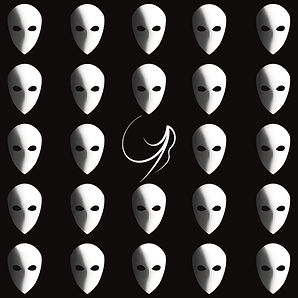
This first version was really fun to put together because it took forever. I did not know that Procreate (the digital art program I use) had a tool that centers selected layers to other layers. So, I lined up every single individual mask by hand, with a plastic ruler held up to the screen. In hindsight, that’s the kind of tool that every program has, so I should’ve just looked it up… But I didn’t!
This version was simple, and lacking a color. I literally half shaded one mask with an airbrush, and then copied it over and over and lined all the copies up. It felt very hollow to me because of how simple it was, and I still needed a color for the song, so I strung the masks together with a yellow string to give it some focus, with a break in the string over the GYB to highlight it.

From here on out, I completely lost the plot on this design. I started by making a couple different variations on how the GYB logo interacted with the image. first I tried tangling it up in the yellow strings, then I tried making it a patch sewn onto the drawing. After that, for whatever reason, my design sense fell completely out the window, and I tried adding a bunch of victorian looking flows background and corner designs. It really got out of hand, so I just went back to the version where the string broke and called it done.

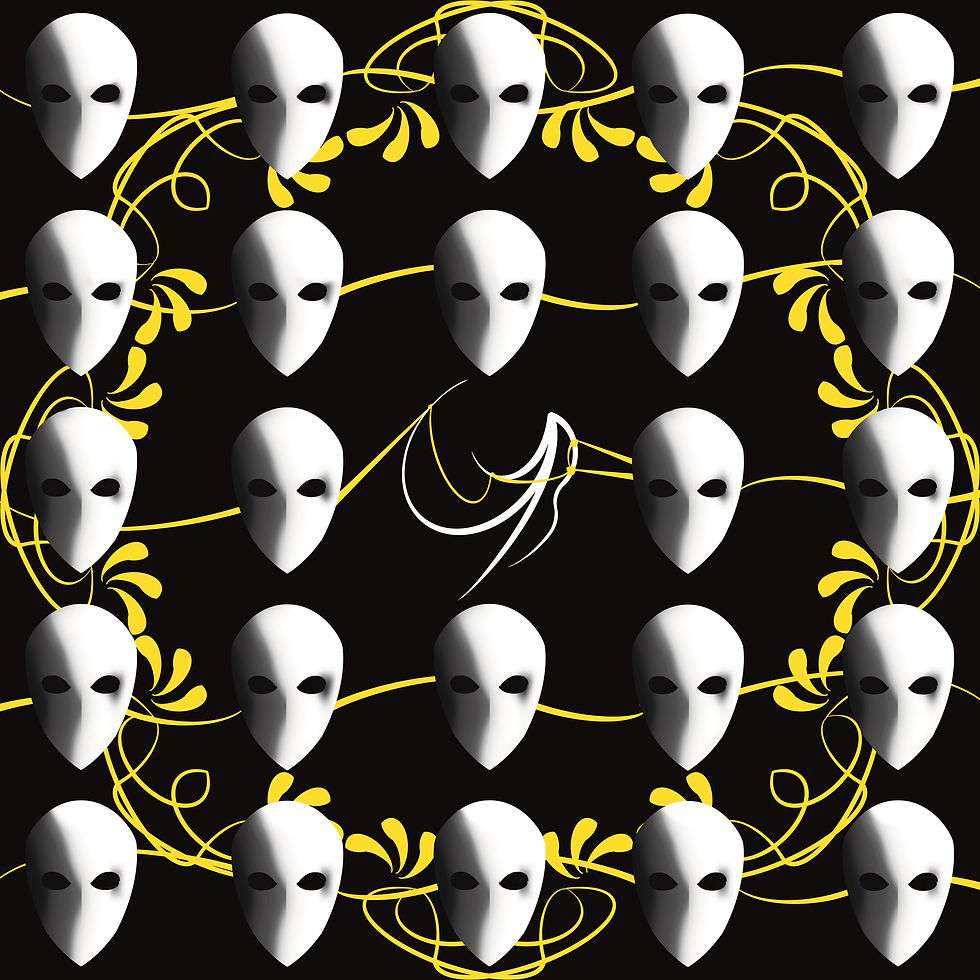

I was pretty set on the design after this point. Like the original censor bar version of “Dead Sound’”s art, I felt I had found a strong visual motif that represented where I wanted to go with the project. Then I realized the designs were all too small to work in context on music streaming services when viewed on phones. So, I went back to the drawing board again.
At first, I had the thought of trying to make a design based on the classic tragedy/comedy masks, with a stereotypically feminine and a stereotypically masculine mask side by side, with the GYB shared between them. I couldn’t get the masks to look the way I pictured in my head though, so I gave up on it pretty quick.

I did however get this horrifying image out of it, so I have that at least!

The second main version (and final version) was kind of an accident. I designed it sometime in late October 2025, alongside the final “Dead Sound” cover. It started when I was flipping back through a sketchbook of mine from earlier in the year, and I found a doodle I had done of a ballerina. For whatever reason, my brain really latched onto this ballerina’s pose, although the anatomy was all wrong. So I found a reference picture of a similar pose, and sketched out a better ballerina. The first image is the initial sketch, the second one is the one inspired by it.


Because Hollow Knight: Silksong was only a couple weeks away at that point, I was playing with a lot of spider webs and thin string in my doodling. So, I took a sharpie to my sketch to experiment with the idea of showing the ballerina tied up, being puppeted by something outside of the canvas and with a noose around her neck. I ended up cutting out some of the strings on the sketch from the final drawing, because it made the image too busy.
The rest of the final version was just a process of taking a picture of the sketch, and tracing it out in my art program. The ballerina didn’t change that much after the sketch, although I did change a number of details around her though. I played around with the idea of making the cover show a mass of gold string at the top, that the ballerina (and potentially a male dancer as well) would be strung up by. However, I both could not find a pose I liked for the male dancer, and I didn’t like the way the rough sketch turned out, so I scrapped it.

I copied the GYB from the “Dead Sound’ canvas over to “The Masquerade” one, that way the logo would be in the same spot. To make it fit in with the drawing, I tried to make it look like the ballerina was tied to the GYB by crossing parts of it overtop her legs. The effect didn’t work too well, but I kept it to try and give the image some cohesion. I also added boarders of yellow string to the edges of the canvas. Even though “The Masquerade” design works on its own without the boarders, it looked better on the small scale to add boarders to emphasize the song’s yellow color. I removed the boarders for the t-shirt version, however, because it looked better to not have them there.
For all intents and purposes, this was the final design. It worked for what I needed to do, and it got the message across pretty succinctly.

Here’s a speed paint of the final version, to show the process of its development. I did make a speed paint for the earlier masks design, but I have since lost it (and possibly deleted it…? I can’t remember). If I find it again at any point I’ll update the end of this article to include it.
© Gavyn Bernhardt. All Rights Reerved.
© Gavyn Bernhardt. All rights reserved.